- #timber-floors
- #queenslander
- #drying
- #brisbane
- #restoration
Solid timber floors in Brisbane Queenslanders can nearly always be saved after water damage if drying starts within a day or two, is done slowly under daily moisture readings, and the subfloor is dried at the same time as the boards. Cupping in the first days is normal and usually flattens; buckling, splitting and long exposure to floodwater force replacement. Rushed drying with heat or strong airflow is the most common way a salvageable floor is ruined.
This article explains what water does to timber, how a restorer dries it without warping, and what the stumps-and-subfloor construction of a Queenslander means for the job.
The Queenslander floor
Brisbane’s pre-war and inter-war houses stand on timber or concrete stumps with a ventilated subfloor space beneath. The floors are solid boards, typically hoop pine in older houses and hardwoods such as spotted gum, blackbutt or brushbox in later ones, laid on joists over bearers with tongue-and-groove joints and a gap to the wall covered by skirting.
The design was intended to keep the house cool and dry: air moves under the floor, and water that lands on the boards drains through the joints rather than pooling. That drainage is a mixed blessing after a leak. Less water stays in the room, but a lot of it ends up in a space nobody looks at.
Post-war brick homes with timber floors over a subfloor behave similarly. Slab homes with timber overlay or floating engineered boards are a different problem, covered in our wet floor drying service page.
What water does to timber
Timber is hygroscopic: it takes moisture in and gives it up according to the humidity around it. In a Brisbane house, floorboards sit at an equilibrium moisture content somewhere around 12 to 15 per cent, higher in summer.
When liquid water arrives, the boards absorb it fast, mostly through the end grain and the joints. As the moisture content rises, the timber expands, mainly across the grain. Three things then happen, in order.
Swelling and tightening. The boards push against each other and against the walls. Gaps close. Some floors go slightly convex across the room.
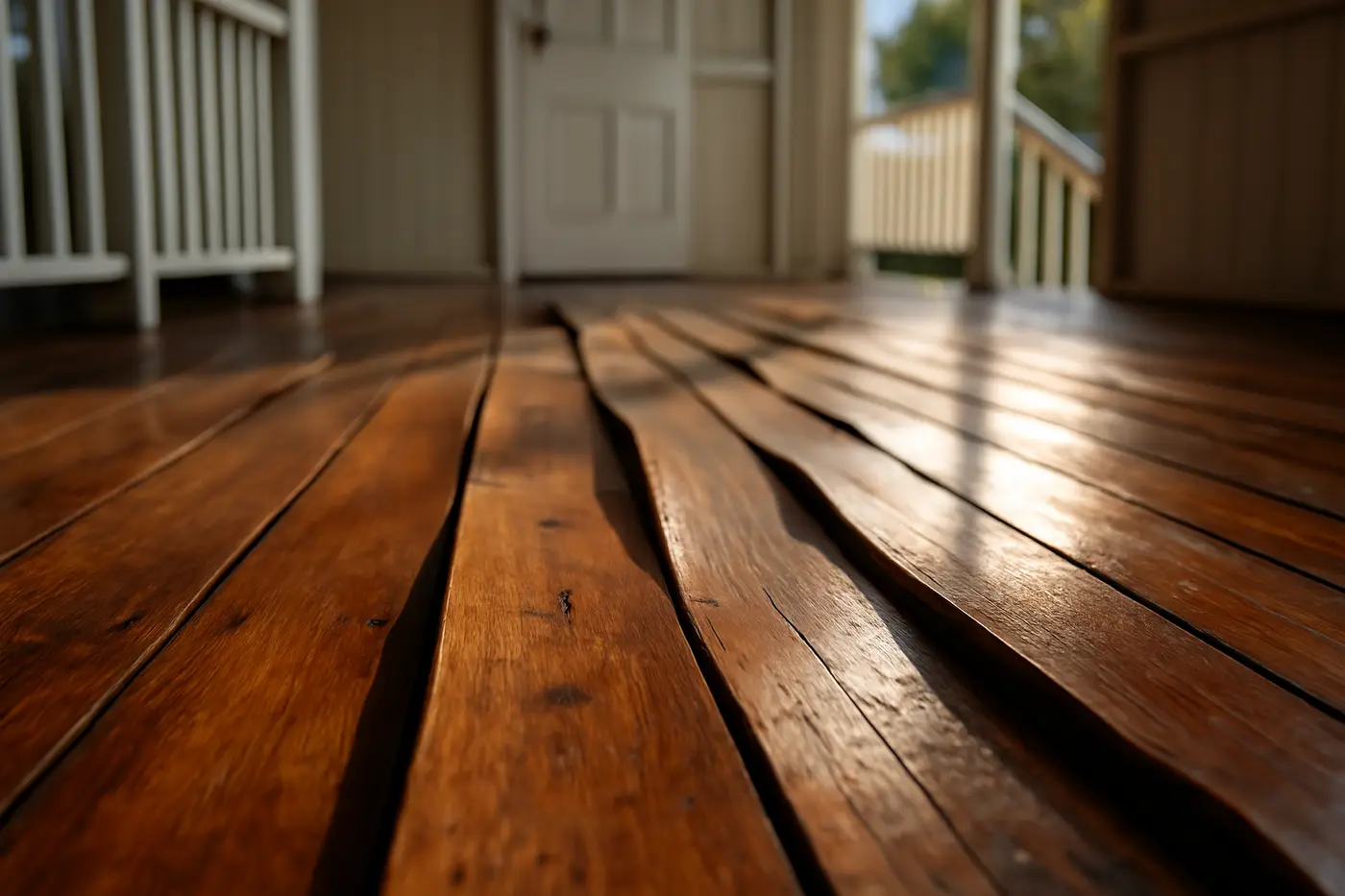
Cupping. If the underside of a board is wetter than the top, or the joints wetter than the centre, the board expands unevenly and its edges rise. The floor takes on a washboard profile. Cupping is reversible if the moisture equalises before the wood fibres are permanently set.
Buckling. When boards have nowhere to expand, they lift off the joists, sometimes in a tent shape along a joint line. Buckled boards have usually pulled fixings and split; they are replaced.
Over a longer period, there is a fourth: decay. Timber kept above about 20 per cent moisture content for weeks becomes a habitat for wood-decay fungi, and softer species like hoop pine are vulnerable. That is a structural issue, not a finish issue.
Why fast drying makes it worse
The instinct after a flood is to get the water out of the boards as quickly as possible: heaters, blowers, open windows on a hot day. On timber, that instinct is wrong.
When the top surface of a board dries rapidly while the underside is still wet, the top shrinks and the bottom does not. The board cups further, and worse, the dried top fibres can set in that position. When the underside finally dries, the board does not flatten; it stays cupped, or reverses into a crown. Rapid drying also causes checking, the fine surface cracks that appear along the grain when the outer fibres shrink faster than the interior can accommodate.
The IICRC S500 approach is to dry timber slowly and evenly, from both faces where possible, keeping the moisture gradient between top and bottom small. That is why timber floor drying takes seven to fourteen days rather than the three to five days typical for carpet on a slab, as our article on drying timelines in Brisbane explains.
How a restorer dries a Queenslander floor
Moisture mapping. Pin meter readings across the floor at a grid, including boards that look dry, plus reference readings from an unaffected room. The underside is read from the subfloor. This map is repeated daily.
Extraction. Standing water is removed from the surface and, where it has pooled on the subfloor soil or on any sheeting, from beneath.
Subfloor drying. This is the step DIY efforts miss. Air movers are positioned under the house to move air across the underside of the boards and the joists. Subfloor vents are cleared. In tight subfloors, ducting brings dry air in.
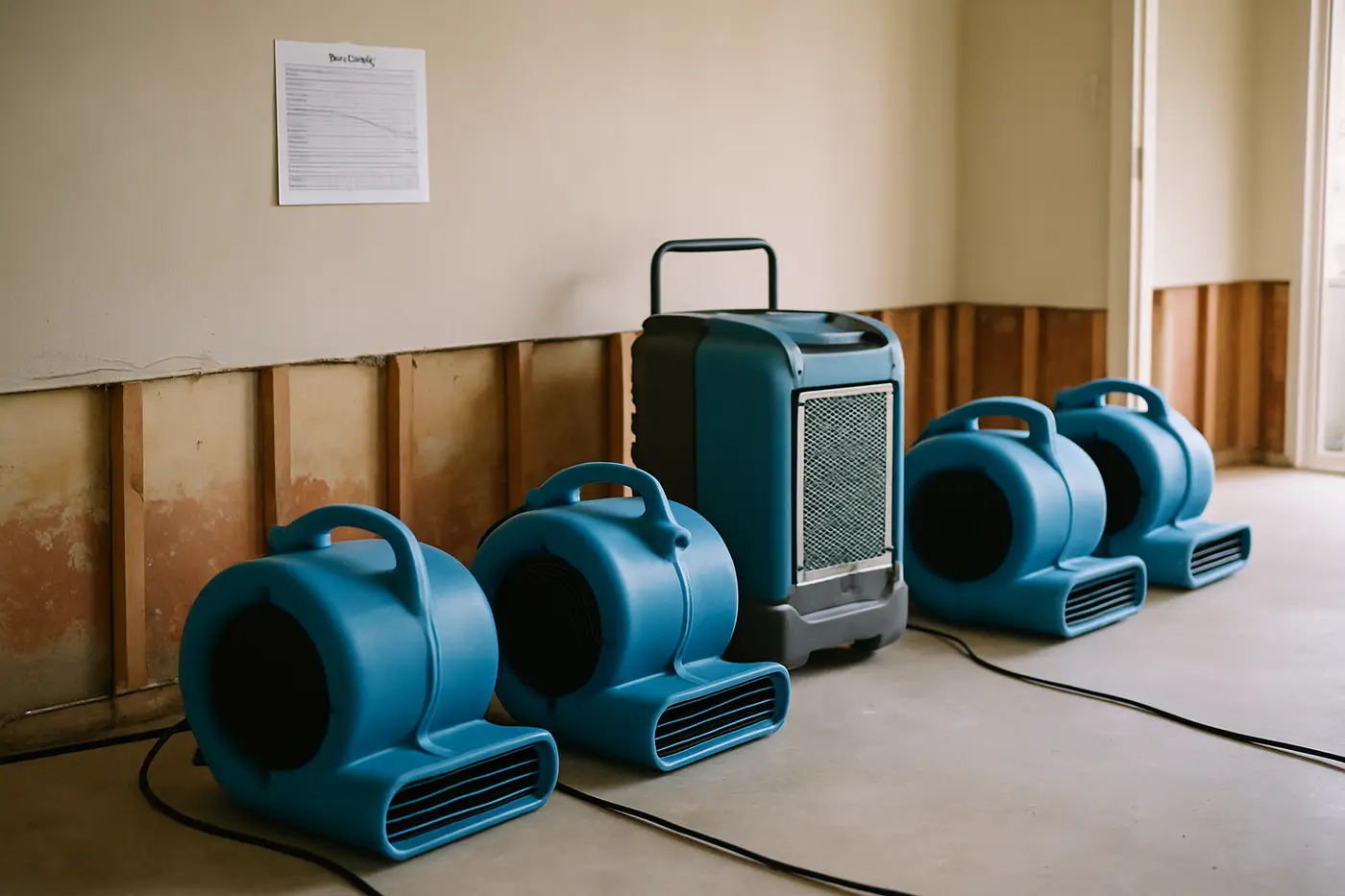
Controlled room drying. In the room above, air movers are set to sweep air across the floor at a moderate rate rather than blasting it. An LGR dehumidifier holds the room at a target humidity that draws moisture out steadily without shocking the surface. The target is a slow, even decline in readings.
Floor drying mats where needed. For floors with a finish that resists evaporation, or where the underside cannot be reached, mat systems that draw air through the joints under vacuum are used.
Monitoring. Daily readings from the same points until top, bottom and subfloor timber are all within tolerance of the dry standard. The equipment stays until the numbers say so, not until the floor looks flat.
Waiting. Once dry, the floor is left for a period, often several weeks, before any sanding, to let the boards finish moving.
What the readings look like
A typical drying log for a hoop pine floor after a clean water event, with readings as moisture content percentage:
| Day | Board top | Board underside | Joist | Room RH % |
|---|---|---|---|---|
| 1 | 32 | 38 | 30 | 82 |
| 3 | 26 | 33 | 27 | 48 |
| 5 | 21 | 27 | 23 | 44 |
| 7 | 18 | 22 | 19 | 42 |
| 10 | 15 | 17 | 16 | 41 |
| 13 | 14 | 14 | 14 | 40 |
| Dry standard | 13 | 13 | 13 | – |
Note the underside lagging the top throughout, which is why subfloor air movement matters, and the slow convergence at the end.
When boards are replaced
Some floors cannot be saved, and a good restorer will say so early rather than spend two weeks and your excess drying a floor that will be replaced anyway.
- Category 3 water. Sewage, creek or river floodwater soaks into timber and cannot be reliably sanitised. Boards that have been submerged in floodwater, as in the creek corridors described in our Brisbane creek flooding article, are usually replaced.
- Buckling with split boards or pulled fixings.
- Prolonged wetting. Boards wet for weeks from an undiscovered leak, showing black staining, softness or fungal growth.
- Delamination of engineered boards, which are not solid timber and behave differently.
- Severe cupping that has set. If the floor was dried badly the first time and has not flattened after stabilising.
Partial replacement is common: a run of boards near the leak is replaced with matching timber and the whole floor refinished. Hoop pine and older hardwoods can be sourced from recyclers across Brisbane.
The subfloor problem in more detail
After every leak on a Queenslander floor, look underneath. Water that went through the boards has landed on the joists, the bearers, the stumps and the ground. In a highset house with a concreted or open under-house area, it drains and dries. In a low-set or enclosed subfloor with poor ventilation, it does not.
Signs that the subfloor is still wet after the room above feels dry:
- A musty smell in the room, worse in the morning.
- Cupping that is not improving or is getting worse.
- Condensation on the underside of the boards when viewed from below.
- Dark staining on joists or the underside of flooring.
- White or grey fungal growth on timber.
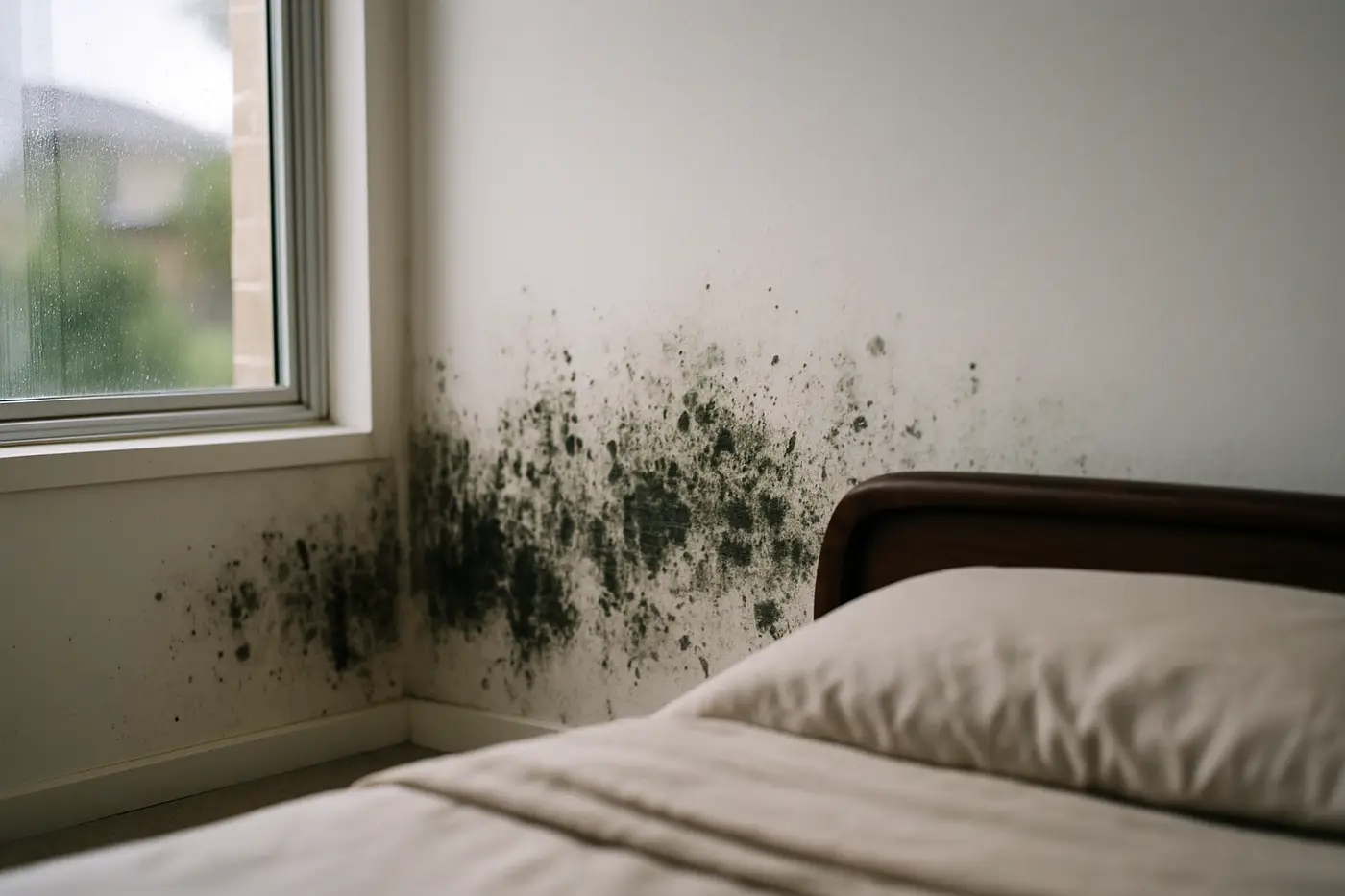
A wet subfloor also feeds mould into the house above; our article on mould after water damage explains how quickly that happens in Brisbane’s humidity. If the subfloor has been wet for more than a couple of days, it needs the same antimicrobial treatment and drying as the floor above.
Blocked subfloor vents, garden beds built up against vent openings and enclosed under-house rooms all slow this drying and should be addressed as part of the job.
Refinishing
Once the timber is stable, the floor is assessed. Light residual cupping on a hardwood floor is often sanded out with a full sand and re-coat. Softer hoop pine has less material to lose; if it has been sanded before, there may not be enough thickness left, and replacement of the worst boards is a better option than a heavy sand.
Do not let anyone sand a floor that has not stabilised. A floor sanded flat while still cupped will crown as it finishes drying, and there is no fixing that except another sand.
Costs
For a Queenslander timber floor after a clean water event in Brisbane, Ipswich or Logan, expect:
- Assessment with moisture mapping: $300–$600.
- Wet floor drying, per area: $400–$1,500.
- Equipment hire: $80–$150 per unit per day, and timber jobs run longer than carpet jobs.
- Refinishing or board replacement: quoted separately by a flooring contractor.
A full clean-water restoration of two or three rooms including timber floor drying sits within the $2,000 to $6,000 range in our 2026 cost guide. The timber itself, especially original hoop pine, is worth far more to the house than the cost of drying it properly.
Key takeaways
- Solid timber floors can usually be saved if drying starts within a day or two and is done slowly.
- Cupping in the first days is normal; buckling, splitting and Category 3 water are not.
- Fast drying with heat or strong airflow causes permanent cupping and checking. Slow and even is the rule.
- The subfloor gets wet too, and it dries slowest. It must be dried and treated.
- Timber takes seven to fourteen days, monitored daily, then a wait before any sanding.
- Do not sand a floor until the readings say it has stabilised.
- Sudden events are insured; a well-documented drying log supports the claim.
If a Queenslander floor is wet now, get air under the house and call for a proper water damage restoration assessment before the boards start to move.