- #sewage
- #black-water
- #emergency
- #health
- #brisbane
If sewage has backed up into your home, stop using every tap, toilet and drain, keep people and pets out of the affected area, switch off power to that area, and call a plumber to clear the blockage and a restorer to clean and sanitise. Do not walk through it, mop it with household cleaners or touch anything porous it has reached. Sewage is Category 3 black water and the contamination extends well beyond what you can see.
That is the immediate answer. What follows explains why sewage is handled so differently from a burst pipe, what the professionals do, and where the lines are between what you can safely do yourself and what you cannot.
What sewage backup looks like in a Brisbane home
It rarely announces itself as a torrent. The usual signs are:
- Water rising in the shower base or bath when the toilet is flushed or the washing machine drains.
- A toilet that fills higher than normal and drains slowly, then overflows.
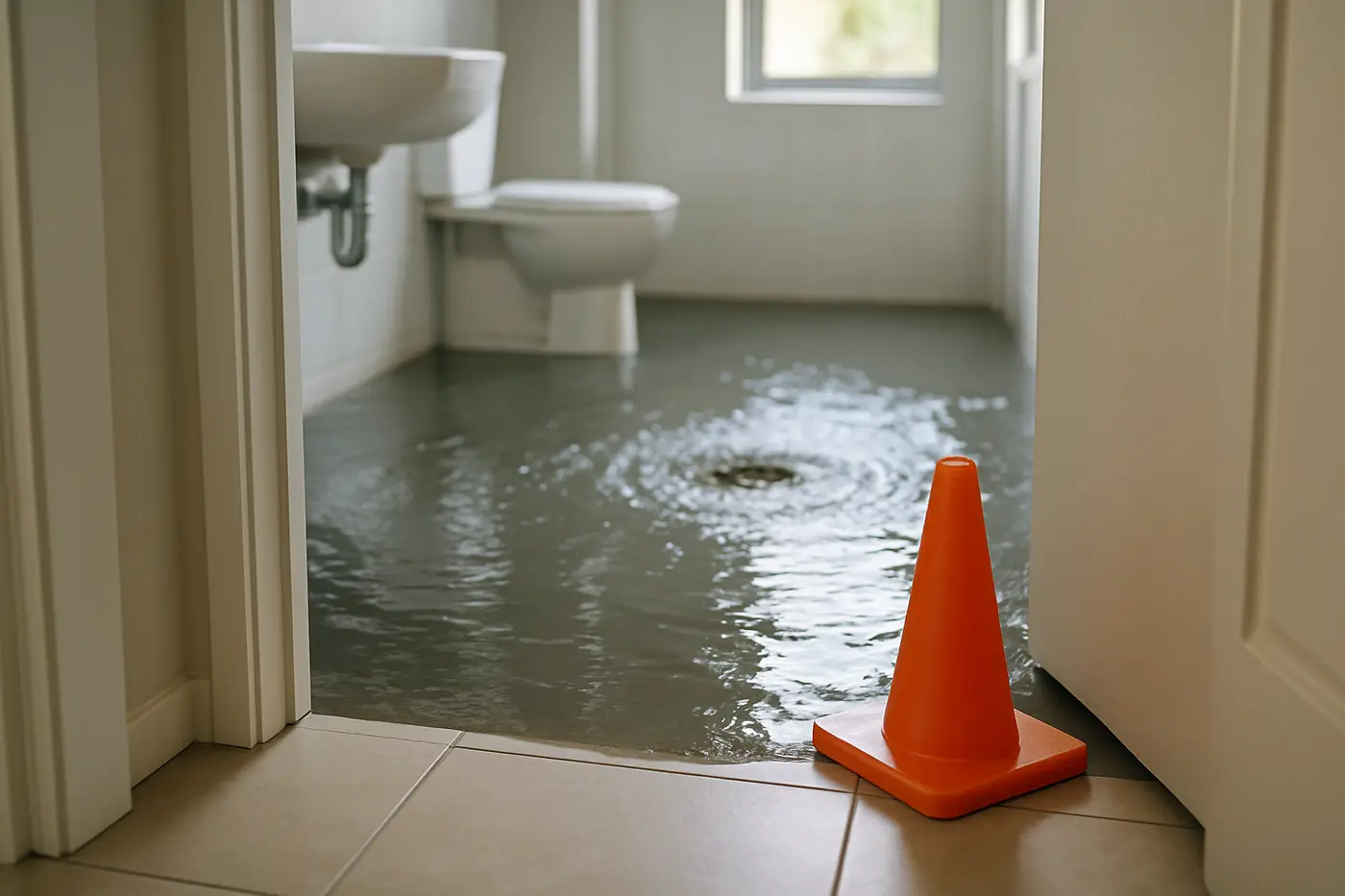
- Grey-brown water bubbling from a floor waste in the laundry or bathroom.
- Gurgling in drains, then a smell.
- Water and solids emerging from the overflow relief gully outside, which is actually the system working correctly.
The lowest fixture in the house is where sewage appears first. In a low-set house that is usually a ground-floor shower or laundry floor waste. In a highset Queenslander it may be a downstairs bathroom added under the house.
Why it happens
Brisbane’s sewer system runs from the house drain to a council main, and a blockage anywhere along that line sends sewage back the way it came.
- Tree roots. The leading cause in established suburbs. Roots enter through joints in older earthenware or concrete pipes, especially in leafy suburbs like Paddington, Ashgrove, Holland Park and Kenmore, and grow into a plug.
- Collapsed or displaced pipes. Old earthenware pipes crack, and reactive clay soils across Brisbane’s western and southern suburbs shift them.
- Foreign objects. Wipes (even “flushable” ones), sanitary items, fat and grease from the kitchen.
- Council sewer surcharge. In heavy rain, stormwater infiltrates the sewer system and the mains overflow. Low-lying houses in creek corridors sometimes get sewage back through the house drain during storms.
- Overflow relief gully problems. If the gully has been buried under paving, raised, or a new bathroom has been installed below it, the sewage comes inside instead of outside.
A plumber with a drain camera identifies the cause. Their report also matters for the insurance claim.
Why sewage is different from a burst pipe
The IICRC S500 standard classifies water damage into three categories. Category 1 is clean water from a supply pipe. Category 2 is grey water with some contamination. Category 3 is black water: sewage, river and creek floodwater, and any water containing pathogens.
Sewage carries bacteria such as E. coli and salmonella, viruses including hepatitis A and norovirus, and parasites such as giardia and cryptosporidium. These are not neutralised by drying. A carpet that has absorbed sewage and been dried is a dry carpet full of pathogens.
The practical consequence is that Category 3 restoration removes contaminated porous materials rather than drying them. That single rule drives everything about how a sewage cleanup proceeds.
The first hour: what to do
- Stop adding water. No flushing, no showers, no washing machine, no dishwasher. Every litre that goes down a drain comes back up.
- Close off the area. Shut the door. Keep children and pets out. If sewage has spread across a floor into living areas, keep everyone out of those rooms too.
- Cut power to affected rooms at the switchboard if sewage is near power points or appliances.
- Open windows in the affected area for ventilation, but keep internal doors closed.
- Call a plumber to locate and clear the blockage. Until it is cleared, the problem continues.
- Call a restorer for sewage cleanup. Ask specifically for a Category 3 response.
- Photograph from the doorway. Do not walk through it for a better angle.
- Notify your insurer and note the plumber’s findings on the cause.
What not to touch
This is the part that separates a manageable event from a health incident and a much larger claim.
| Do not | Because |
|---|---|
| Walk through sewage in bare feet or ordinary shoes | Pathogens enter through cuts and are tracked through the house |
| Mop it up with household cleaners | Spreads contamination; domestic cleaners do not sanitise porous surfaces |
| Use a household vacuum or carpet cleaner | Aerosolises pathogens through the exhaust and contaminates the machine |
| Try to rinse carpet or rugs | Drives contamination deeper into underlay and subfloor |
| Run fans or air-conditioning in the affected area | Spreads aerosolised contamination through the house |
| Handle contaminated items without gloves and a mask | Direct exposure |
| Put contaminated porous items in the general bin without bagging | Council collection staff exposure; some items require specific disposal |
| Move furniture out through clean rooms | Drips and tracks contamination |
If you must enter the area, wear rubber boots, waterproof gloves and a P2 mask, and remove and bag the clothing afterward.
What the professionals do
A Category 3 cleanup follows a defined sequence. Knowing it helps you judge whether a quote is complete.
Assessment and containment. The technician identifies every surface and material the sewage has contacted, including under floors and behind skirting boards, using moisture meters and sometimes a borescope. The affected area is isolated from the rest of the house with plastic sheeting where needed.
Bulk removal. Solids and standing liquid are removed with equipment dedicated to contaminated water, not the same extractor used on clean water jobs.
Removal of porous materials. Carpet, underlay, wet plasterboard (cut above the contamination line), MDF and particleboard cabinetry, wet insulation, and any fabric or paper contents. Everything is bagged and disposed of through appropriate channels.
Cleaning. Hard surfaces, tile, concrete, framing timber and masonry are pressure-cleaned and scrubbed with detergent to remove organic material. Disinfectant does not work on dirty surfaces, so cleaning comes first.
Sanitising. A hospital-grade antimicrobial is applied to every affected surface, including subfloor timbers and wall cavities. Contact time is observed.
Drying. Air movers and an LGR dehumidifier dry the structure that remains, monitored daily until the dry standard is reached. In Brisbane’s humidity, this stage takes three to seven days after strip-out, as explained in our guide to how long drying takes.
Verification. Surfaces are checked, sometimes with ATP swabs that measure biological residue, before the area is released for rebuild.
Documentation. Photos, a moisture log, a list of materials removed and a description of the sanitising process, for the insurer and for your records.
Costs and insurance
Sewage cleanup and sanitisation in Brisbane, Ipswich and Logan typically costs $2,500 to $8,000. A multi-room Category 3 restoration with drying and disposal runs $6,000 to $15,000 or more. The plumber’s charge to clear the blockage is separate, as is the rebuild. Our 2026 cost guide sets out the full price list.
Most Queensland home policies cover sudden escape of liquid including sewage, and the resulting cleanup, less the excess. Common exclusions are:
- Backup from the council sewer, on some policies.
- Damage from a blockage the owner knew about and did not fix.
- Gradual leaks from a cracked drain that have been seeping for months.
The plumber’s report on the cause and the restorer’s Category 3 documentation are what the assessor reads. Photograph the event, keep the reports and lodge the claim quickly.
Preventing the next one
- Find your overflow relief gully. It is a grated outlet outside, usually near the bathroom or laundry wall. Make sure it is not paved over, that its grate is loose-fitting, and that it sits at least 150 mm below the lowest internal fixture and above the surrounding ground.
- Nothing but toilet paper down the toilet. Wipes do not break down.
- Keep fat out of the kitchen sink.
- Have the drain camera-inspected if you have mature trees near the sewer line and the house is more than thirty years old. Root cutting or relining is far cheaper than a cleanup.
- Install a backflow valve if your area has a history of sewer surcharge in storms.
Key takeaways
- Sewage is Category 3 black water. It is a contamination event, not a cleaning job.
- Stop using all water fixtures, close off the area, cut power near it, call a plumber and a restorer.
- Do not mop, vacuum, rinse or run fans in the affected area.
- Porous materials that touched sewage are removed, not dried. Hard surfaces are cleaned, then sanitised, then dried.
- Expect $2,500 to $8,000 for cleanup and sanitisation; more for multiple rooms.
- Insurance usually covers sudden backups; keep the plumber’s report.
- Check your overflow relief gully. It exists to keep sewage outside.
If sewage is in the house now, close the door and make the calls. Our sewage cleanup crews cover Brisbane, Ipswich and Logan with Category 3 equipment and protective gear.