In depth
Water Damage Restoration in Brisbane: how the job actually runs.
Water damage in Brisbane rarely announces itself politely. It is a flexi hose under the kitchen sink that lets go at 2 am, a hot water system that rusts through on a long weekend, or an afternoon supercell that overwhelms the gutters and sends water down the inside of a wall. Whatever the source, the clock is the same: in our sub-tropical humidity, wet building materials start growing mould within 24 to 48 hours. Water damage restoration is the discipline of beating that clock.
What water damage restoration involves in Brisbane conditions
Restoration is not just mopping up. The IICRC S500 standard breaks the work into stages, and each one matters.
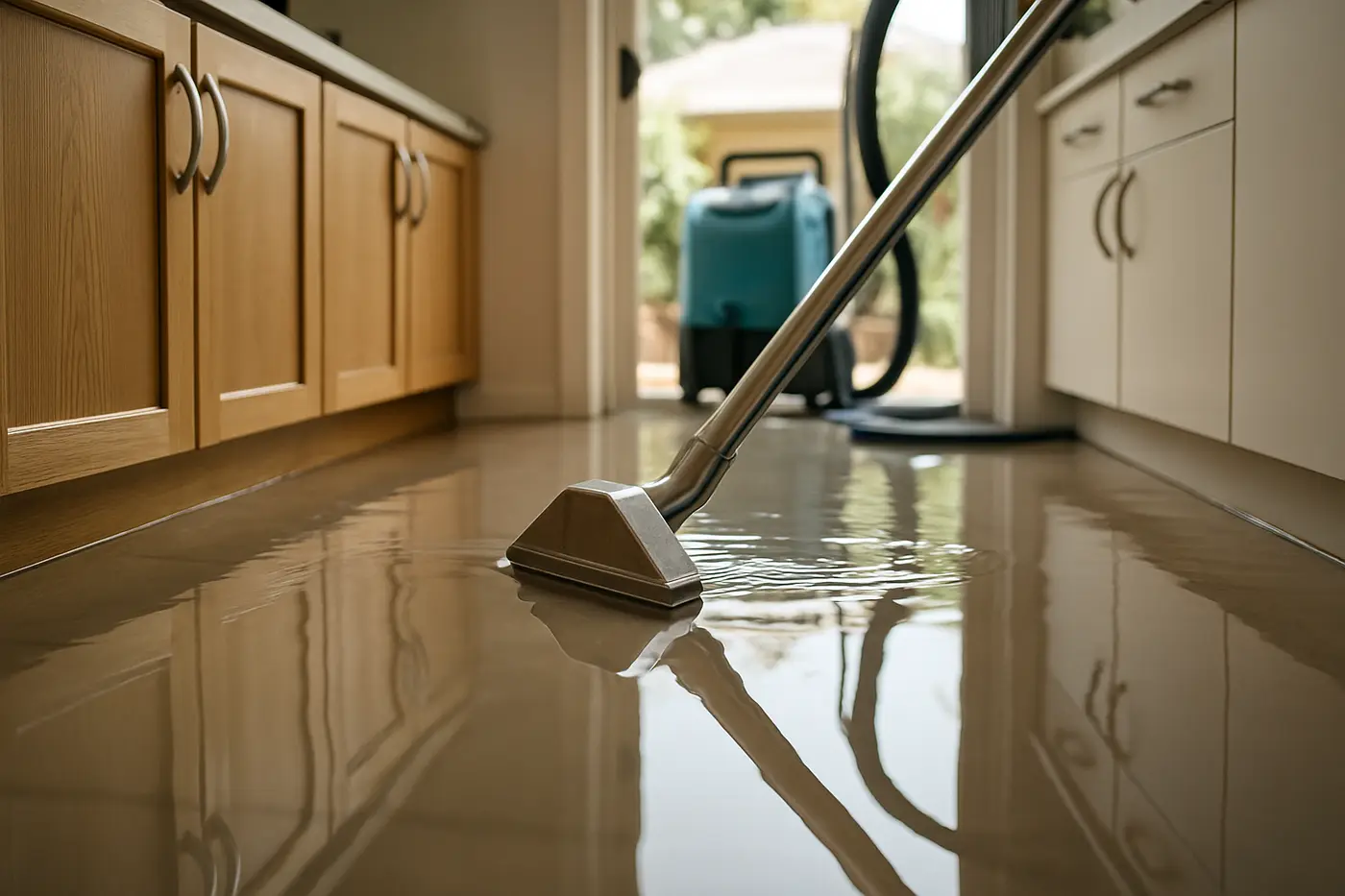
Extraction removes bulk water as fast as possible. Every litre we pull out with a truck-mount or portable extractor is a litre a dehumidifier does not have to evaporate later, which is the single biggest lever on drying time and cost.
Assessment and moisture mapping comes next. We meter walls, floors, skirting and subfloors with pin and non-invasive moisture meters and check for hidden migration with a thermal camera. Water travels sideways along bottom plates and under floor coverings, so the wet area is almost always bigger than the visible stain.
Category and class are decided at this point. Category 1 (clean supply water) can usually be dried in place. Category 2 (grey water from appliances, or clean water that has been sitting) needs antimicrobial treatment. Category 3 (black water from sewers, creeks or rivers) means removal of porous materials. Class 1 to 4 describes how much water the materials are holding and how hard it will be to evaporate — a wet slab with tiles on top (Class 4) is a very different job from a damp corner of carpet (Class 1).
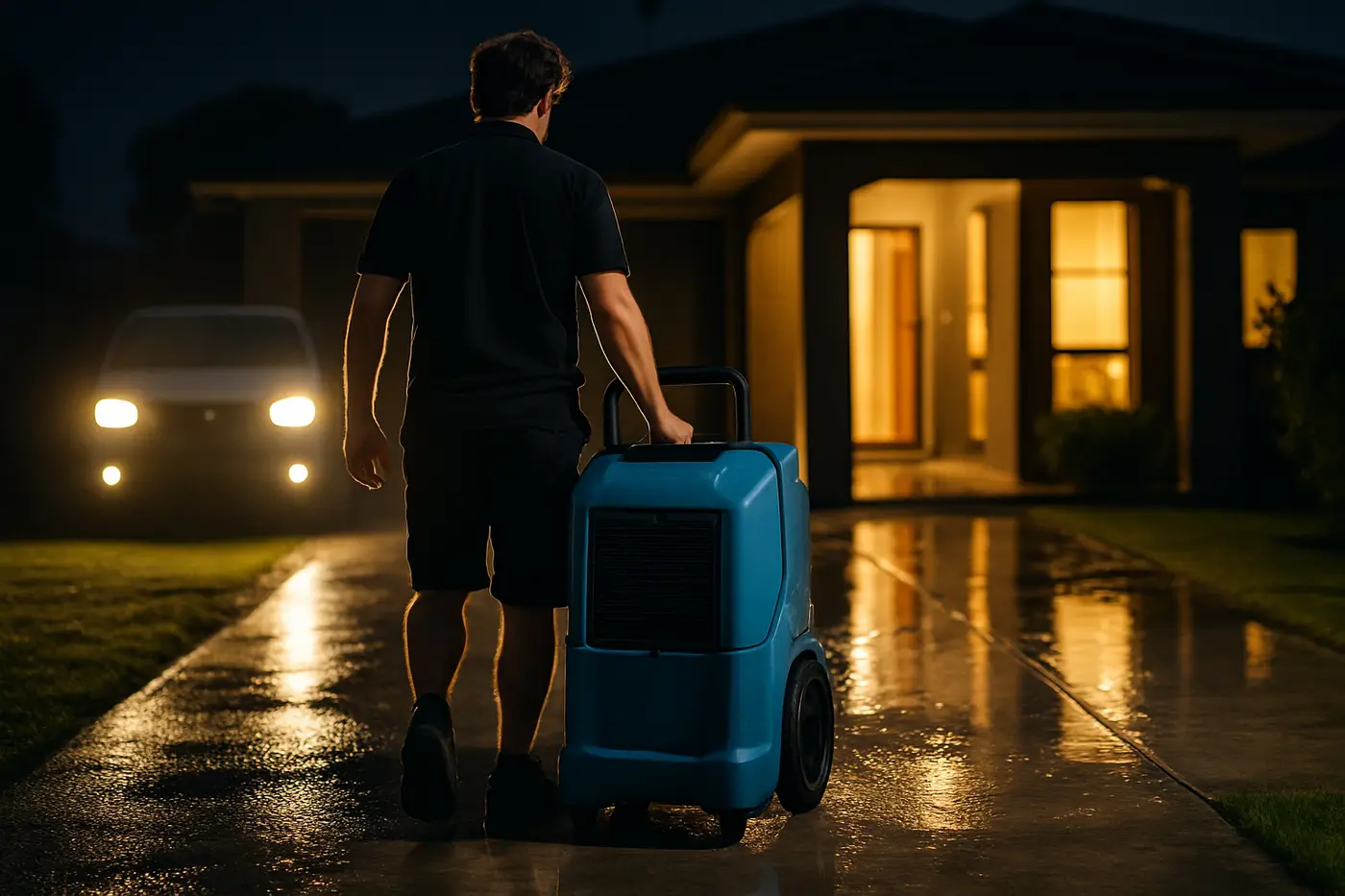
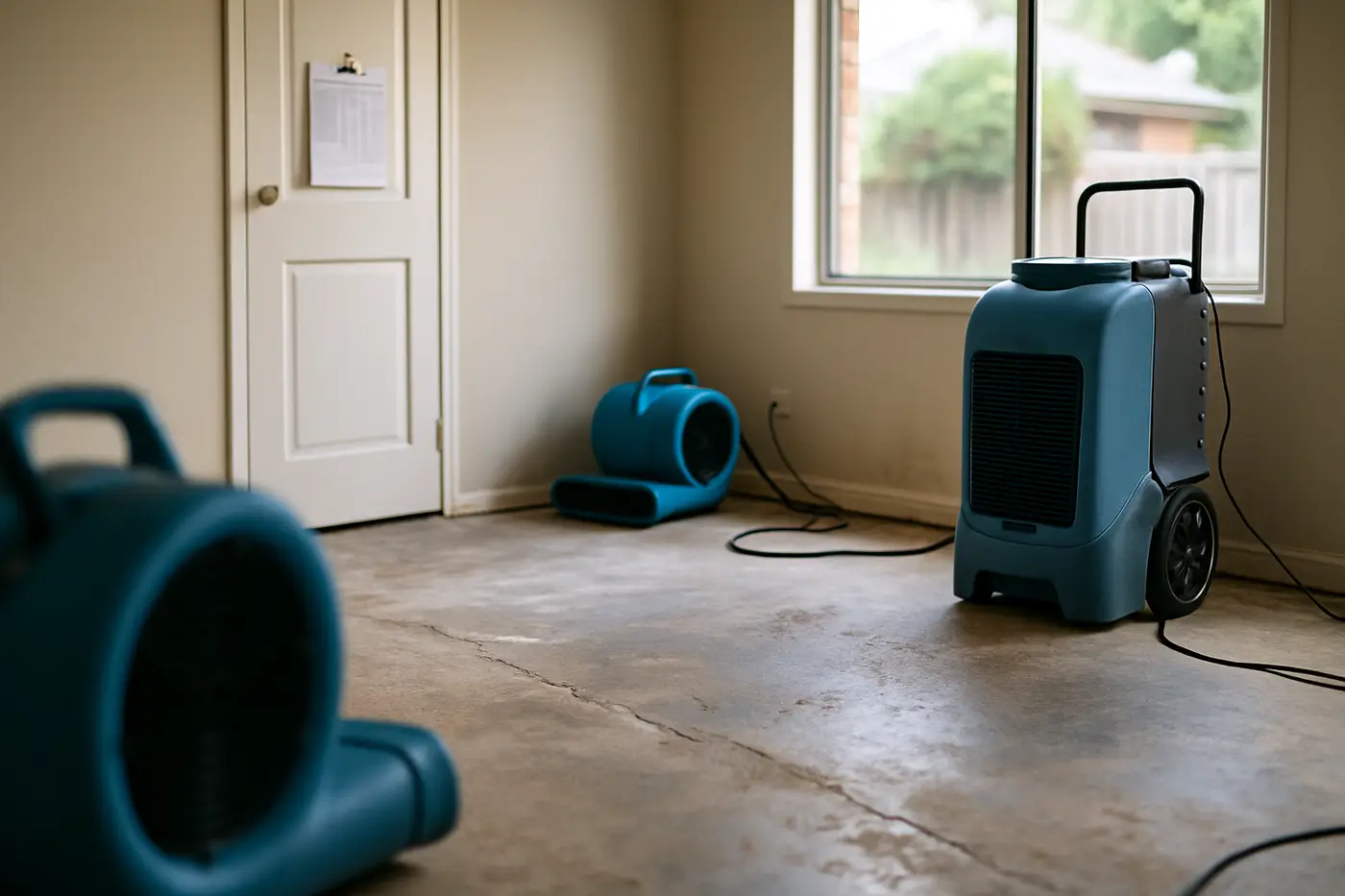
Structural drying uses air movers to lift moisture off surfaces and low-grain refrigerant (LGR) dehumidifiers to strip it from the air. We size the equipment to the evaporation load and log readings daily.
Repair replaces what could not be saved and returns the property to pre-loss condition.
The drying science: why it takes three to five days
People often ask why a small leak takes most of a week to dry. The answer is psychrometrics. Water leaves a wet material only as fast as the surrounding air can accept it, and Brisbane summer air at 70 to 80 per cent relative humidity has very little room left. Air movers push warm, dry air across wet surfaces to keep evaporation going; dehumidifiers pull that moisture back out of the air so the cycle can continue. If either half is missing, drying stalls.
What the meters tell us
Every day on site we record three things: the temperature and relative humidity of the room air, the grain depression across each dehumidifier (how much water it is actually removing), and the moisture content of the affected materials. Dry timber in Brisbane sits around 10 to 14 per cent moisture content; anything above 18 per cent will support mould. Gyprock is compared against an unaffected reference wall in the same house. The job is finished when the readings meet dry standard, not when the surface feels dry to the hand. Surface-dry gyprock over a wet bottom plate is exactly how a $3,000 drying job becomes a $10,000 mould job in March.
The first hour: what to do before we arrive
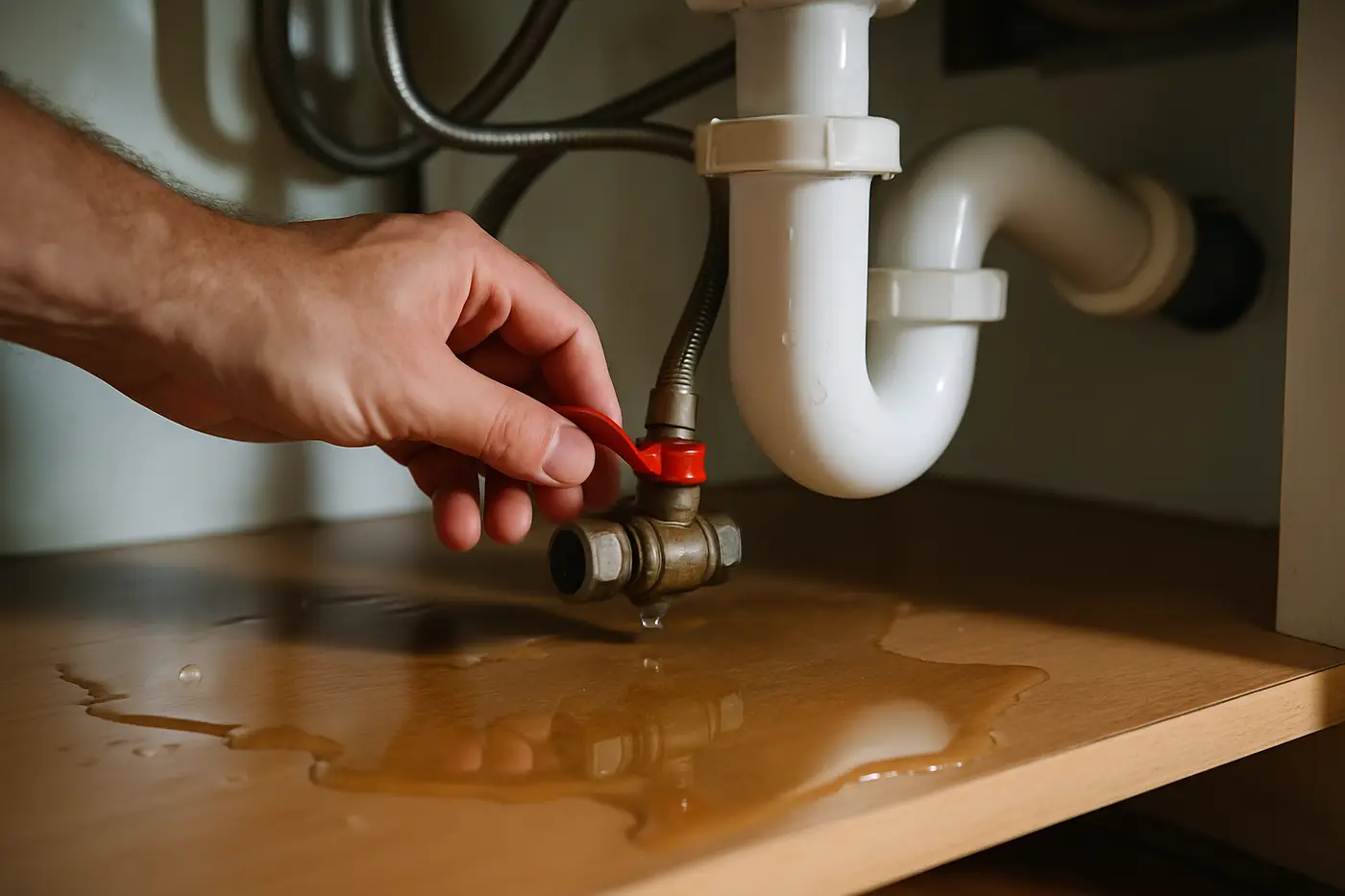
- Stop the source. Isolator valve under the sink or toilet, or the mains tap at the meter. For a hot water system, turn off both the cold feed and the power or gas.
- Cut power to wet circuits at the switchboard. Do not touch the board if it is wet or if you are standing in water.
- Lift what you can. Rugs off carpet, furniture onto foil or blocks, cardboard boxes off the floor. Timber furniture legs stain carpet permanently within hours.
- Photograph everything before it is moved, including the failed hose or appliance. Keep the failed part.
- Do not turn on ceiling fans or air-conditioning if the water may be contaminated, and do not run a domestic vacuum on standing water.
Insurance and documentation
Most home policies in Queensland cover sudden escape of liquid and storm damage. The friction usually comes from two places: proving the damage was sudden rather than gradual, and showing that mitigation was reasonable. Insurers expect daily moisture logs, dated photos and a scope that explains why each material was removed or retained. We produce all of it as standard, and where an insurer approves direct billing we can invoice them rather than you.
Two things to know: the Insurance Council of Australia’s standard flood definition (since 2012) means river and creek flooding is a separate cover from storm, and many Brisbane policies exclude or limit it. Check your PDS now rather than after the Bremer or Bulimba Creek rises. Second, a Brisbane City Council FloodWise Property Report or the Ipswich City Council flood maps will tell you which kind of water your house is exposed to.
Brisbane, Ipswich and Logan: how water behaves in local housing
Queenslanders on stumps in Paddington, New Farm and Ipswich have timber floors over a ventilated subfloor. Water goes through the boards and, if the subfloor is open, often dries well. The risk is enclosed subfloors and VJ walls, which wick water upward.
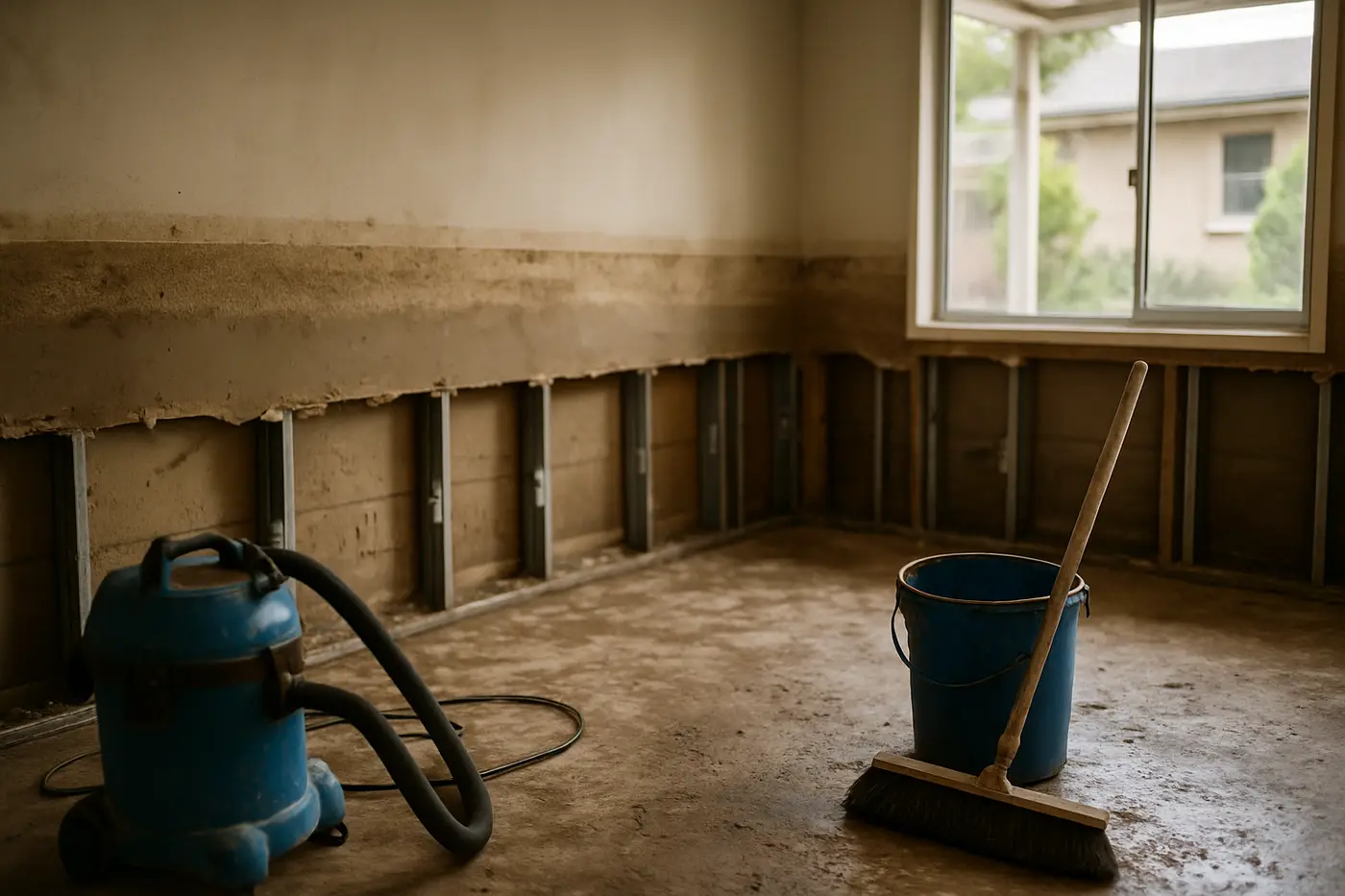
Post-war brick veneer and 1970s–80s brick-and-tile on slab across Chermside, Sunnybank, Mount Gravatt and Springwood hold water in the slab and the bottom plate. Tiles over a wet slab are the slowest drying scenario we see and usually need heat and containment.
Modern estates at Springfield Lakes, Redbank Plains and North Lakes use particleboard flooring on low-set slabs, and particleboard that swells does not come back. Fast extraction is critical.
Flood corridors matter too. Enoggera Creek, Kedron Brook, Bulimba Creek, Oxley Creek and Norman Creek in Brisbane, the Bremer in Ipswich and the Logan and Albert Rivers in Logan all delivered Category 3 water into homes in 2011 and again in February 2022, when some suburbs recorded around 700 mm in three days.
Repair or replace?
| Material | Usually dried and kept | Usually removed |
|---|---|---|
| Carpet (Cat 1, under 48 hrs) | Yes, with underlay assessed | Cat 2 or 3, or delaminating |
| Carpet underlay | Rarely — cheap, slow to dry | Most jobs |
| Standard gyprock | Cat 1, dried within 48 hrs | Cat 2/3 or sagging |
| Solid timber floor | Yes, with controlled drying | Severe cupping or Cat 3 |
| Particleboard floor | Only if barely damp | Any swelling |
| Insulation (batts) | No | Always when wet |
| Concrete slab | Always dried in place | Never |
What drives the cost
Water damage restoration in Brisbane typically runs $2,000 to $6,000 for a clean-water loss across two or three rooms, and $6,000 to $15,000 or more where grey or black water has spread through multiple rooms. The drivers are simple: how much water, how contaminated, how long it sat, what it soaked into, and how much has to be removed and rebuilt. Call-out and assessment is $300 to $600 and is credited against the restoration if you proceed. Equipment runs $80 to $150 per unit per day, and a typical three-room job uses six to ten units.
The cheapest water damage job is always the one that starts today. If you are standing in water in Brisbane, Ipswich or Logan, get in touch now and we will tell you what to do in the next ten minutes while we are on the way.
Last updated 12 September 2026